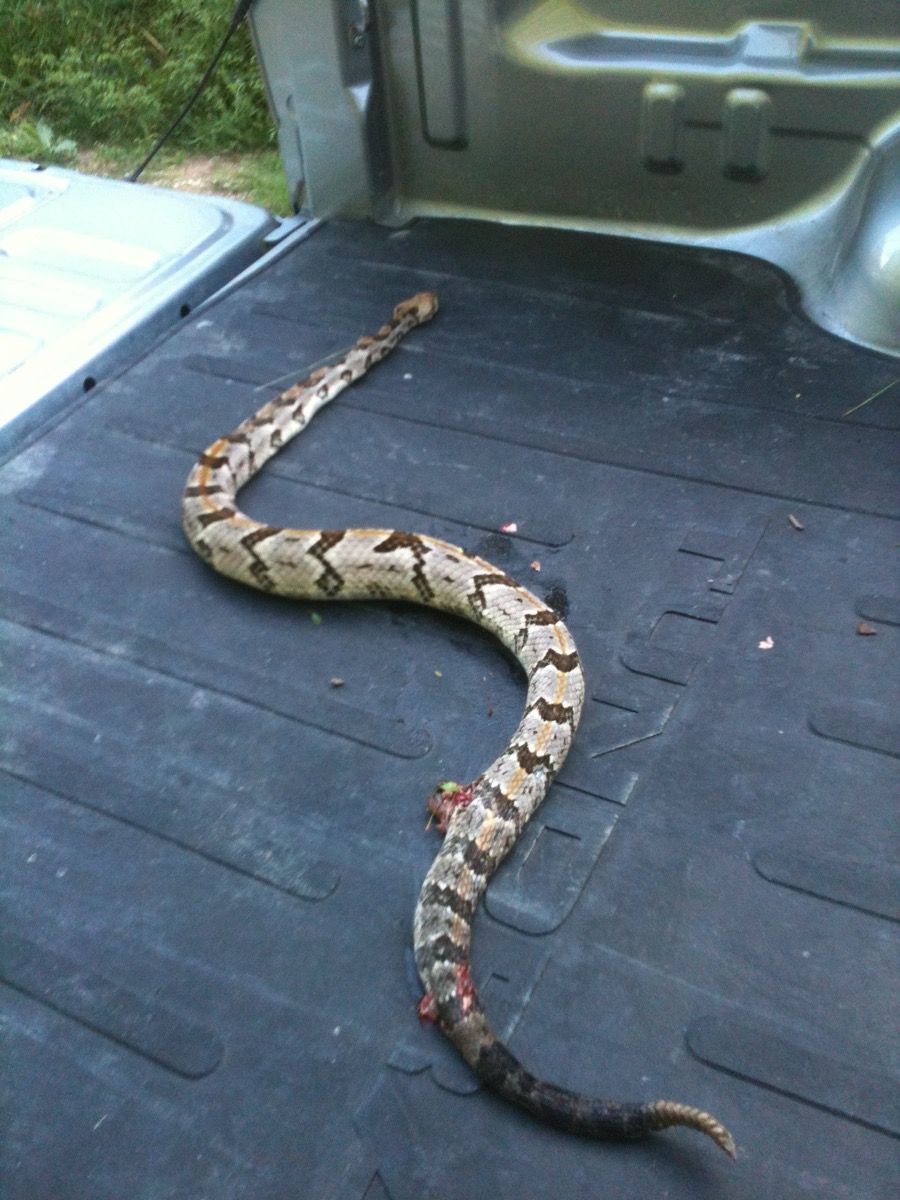
Cane break rattler
 A typical email exchange with my dad.
Dad: Up along the East Coast and in New England the snake is indeed called a Timber Rattlesnake – it was the snake featured prominently during the American Revolution with the motto “Don’t Tread on Me”. That’s still pretty good advice.
Then, down thru the Appalachian Mountain country and the costal country and swinging west as far as where I live, here in Louisiana, they share the range with Eastern Diamondback rattlesnakes; which can get bigger than even the biggest Timber rattler. I killed a big Diamondback when I was a kid working in a cotton field that measured 7’11 ½” from his nose to the tip of his rattles. He was as long as the bed on my old ‘longbed’ 1954 F100 pickup. I showed that snake all over town. People took pictures and measured him and measured him again. That afternoon I sold him to one of my father’s semi-outlaw friends for, as I remember, about $12. That was a lot of money in 1962. Gasoline was $0.23 a gallon at the local Gulf station. They had old-time nickel slots in there, right in the front, and a card game going all day in the back.
But, back to Canebrake rattlesnakes: There is still debate among wildlife biologists as to whether the Canebrake and the Timber Rattlesnake are the same species, or, if the Canebrake is in reality a different snake, a separate subspecies.
I’ve killed a few Timber Rattlers in the North Mississippi hills, and up in middle- Tennessee, around the farm where my mother’s grandfather walked to, starving, a couple of years after he stood at attention at Appomattox Courthouse and watched RE Lee surrender to US Grant; one of two men I consider to be the only true military geniuses of that entire and recent unpleasantness, which was called by some a “civil” war.
Anyway, my great grandfather was standing with the small remnant of the 26th North Carolina who’d actually survived the ‘duration’ of that war. And he later wound up in the hills of Tennessee, where he married a pretty brown-haired local hillbilly girl whose name was Missouri Stevens. They eventually had eight children, six of whom survived to adulthood. I’d visit up there, up on their little hill farm, during the summers, sometimes, when I was a kid; they had Timber rattlers there, mostly, and a few Diamondbacks and lots of Cottonmouths along and in the creek. Sometimes we’d catch rattlesnakes in the creek, too. All of which my cousins and I would kill, unless we were barehanded. Then we’d just back away real carefully.
Well, I’ve lived here in Louisiana, man and boy, most of my life, and I like the big hardwood timber. I know a lot about our swamps and old timber and the creatures that live in them; and it my personal opinion that they are different snakes, the Canebrake rattler and the Timber rattler. But it’s nothing but my opinion, which isn’t worth, really, the time it’s taking you to read this overlong note.
Anyway, I don’t dance around with them and charm them, or let them bite me like some of these snake-wiggling, holy-rolling, tongue-speaking, sweating, eye-rolling, shaking, shout to Jesus and the Holy Ghost Pentecostals do.
I generally kill just them, the big ones anyway. They can hurt you, they’re dangerous to man and beast. That snake, yesterday, was the 1st full-grown one I’ve run across in about a year. So I killed it and brought it home and skinned it and scraped it and washed it and salted it and rolled it up. I’ll stretch it out in about a week and tack it to a board.
Oh, when I stretched him out straight on my shop table to skin him, I actually put a tape measure on him: he was just a fraction over 65”. Nine rattles and a button, with a big old spade-head about the size of a woman’s fist. His girth was just a little bigger than my upper arm.
Me: how did you kill him exactly?
Dad: With a stick. I was empty handed when I saw him.